About Tết
Tết — short for Tết Nguyên Đán, 'festival of the first morning' — is Vietnam's lunar new year, the country's most important annual holiday and a week-long public observance. Like its East Asian cousins it falls on the second new moon after the winter solstice. The seven days before Tết are devoted to cleaning the house, settling debts, and preparing the kitchen god to fly to heaven on a carp's back to deliver his report on the household.
For a deeper historical treatment, see Tết — Wikipedia.
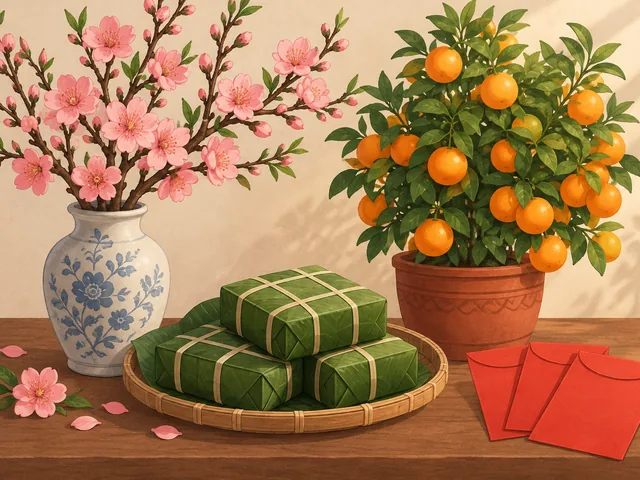
The festival's two signature foods are bánh chưng (square sticky-rice cakes wrapped in dong leaves, made the day before Tết) and bánh tét (the cylindrical southern cousin). The southern home is decorated with branches of yellow apricot blossom (hoa mai); the northern home with pink peach blossom (hoa đào). Children receive lì xì — red envelopes of new-year money — from elders, and the first visitor of the new year (xông đất) is selected carefully, since their fortune is held to set the household's luck for the year.
Traditional greetings
The phrases below are the ones most often used to mark Tết in person, by phone, and on cards. The native-script column shows the greeting as a recipient would read it; the transliteration is for those who would like to say it aloud; the English column is a literal rather than a poetic translation.
| Language | Greeting | Transliteration | English |
|---|---|---|---|
| Vietnamese | Chúc mừng năm mới | Happy New Year | |
| Vietnamese | An khang thịnh vượng | Peace, health, and prosperity | |
| Vietnamese | Vạn sự như ý | May ten thousand things go as you wish | |
| Vietnamese | Sức khỏe dồi dào | Abundant health |
Design tips for printable Tết cards
Hand-printed cards for Tết reward restraint and specific reference. The notes below distil what the most thoughtful cards in the tradition tend to do — and what the most commercial ones tend to get wrong.
- Apricot blossom (yellow, southern) for cards bound for HCMC and the diaspora; peach blossom (pink, northern) for Hanoi.
- Bánh chưng — perfectly square, deep green leaf, tied with split bamboo cord — is a beautiful, legible cover.
- Use the colour of a fresh dong leaf (deep saturated green) as the dominant, with red and gold as accents only.
- Vietnamese calligraphic script (chữ Nôm or modern handwritten) reads warmer than Western typefaces here.
- A folded pocket for lì xì cash is the most beloved feature.
A starting palette:
Five verses for Tết cards
Each verse below is short enough to copy onto a folded card by hand. They progress from formal to intimate; pick the one that best fits the relationship and the year you are writing into.
- Chúc mừng năm mới — happy new year. May the apricot blossom bloom on time, and may every guest find your door open.
- An khang thịnh vượng — peace, health, prosperity. Three old wishes that never quite go out of style.
- From our bánh chưng to yours, from our family altar to yours, a bright year ahead.
- Vạn sự như ý — may ten thousand things go the way you hoped, and the rest go better than you feared.
- May the first visitor of the year bring you luck, and may the last hour of the old year leave nothing important behind.
Related cultural holidays
Other holidays observed in the East Asia & Pacific family of traditions: