
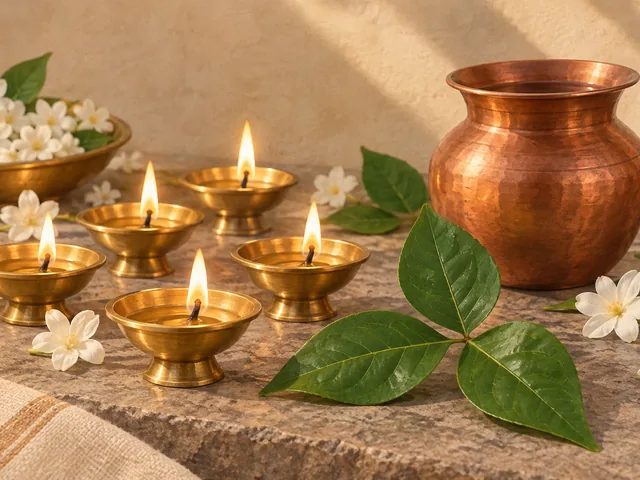
About Maha Shivaratri
Maha Shivaratri — 'the great night of Shiva' — falls on the moonless fourteenth night of Phalguna and is unusual among Hindu festivals for being kept primarily at night, in stillness rather than spectacle. Devotees fast through the day, gather at Shiva temples after sundown, and stay awake through four prahars (three-hour watches), each with its own bathing of the lingam — milk, curd, ghee, honey — and recitation of the Rudram.
For a deeper historical treatment, see Maha Shivaratri — Wikipedia.
Multiple legends overlap on the date: the night Shiva performed the Tandava, the night he drank the poison Halahala to save the world (turning his throat blue), and the night of his marriage to Parvati. The festival is not exuberant — it is contemplative, a quiet Hindu Yom Kippur — and cards sent for it tend to be small, dignified, and reflective.
Traditional greetings
The phrases below are the ones most often used to mark Maha Shivaratri in person, by phone, and on cards. The native-script column shows the greeting as a recipient would read it; the transliteration is for those who would like to say it aloud; the English column is a literal rather than a poetic translation.
| Language | Greeting | Transliteration | English |
|---|---|---|---|
| Sanskrit | ॐ नमः शिवाय | Om Namah Shivaya | I bow to Shiva |
| Hindi | महाशिवरात्रि की शुभकामनाएँ | Maha Shivaratri ki shubhkamnayein | Maha Shivaratri wishes |
| Tamil | மகா சிவராத்திரி நல்வாழ்த்துக்கள் | Maha Sivarathri nalvazhthukkal | Maha Shivaratri good wishes |
Design tips for printable Maha Shivaratri cards
Hand-printed cards for Maha Shivaratri reward restraint and specific reference. The notes below distil what the most thoughtful cards in the tradition tend to do — and what the most commercial ones tend to get wrong.
- Reach for moonless-night palettes: indigo, charcoal, deep teal, with a single point of gold or white.
- A simple lingam silhouette beneath a crescent moon is more reverent than a portrait of Shiva.
- Bilva (bel) leaves — three-lobed and offered to the lingam — make a beautiful corner motif.
- Use uncoated stock with deckled edges; the festival is not the moment for foil and gloss.
- Inside, leave room for a single line of mantra in Devanagari and nothing else.
A starting palette:
Five verses for Maha Shivaratri cards
Each verse below is short enough to copy onto a folded card by hand. They progress from formal to intimate; pick the one that best fits the relationship and the year you are writing into.
- On the night the world goes still, may you find the part of you that is also still. Om Namah Shivaya.
- Four watches, one moonless night, and a god who held the poison so we wouldn't have to — blessings for your Shivaratri.
- May whatever needs to end this year find its rest tonight. And may whatever needs to begin find its first quiet breath.
- Bilva leaves on the lingam, a small lamp by the door, and the long night kept together — Maha Shivaratri ki shubhkamnayein.
- The destroyer is also the renewer. What falls away tonight is only making room.
Related cultural holidays
Other holidays observed in the South Asia family of traditions: