
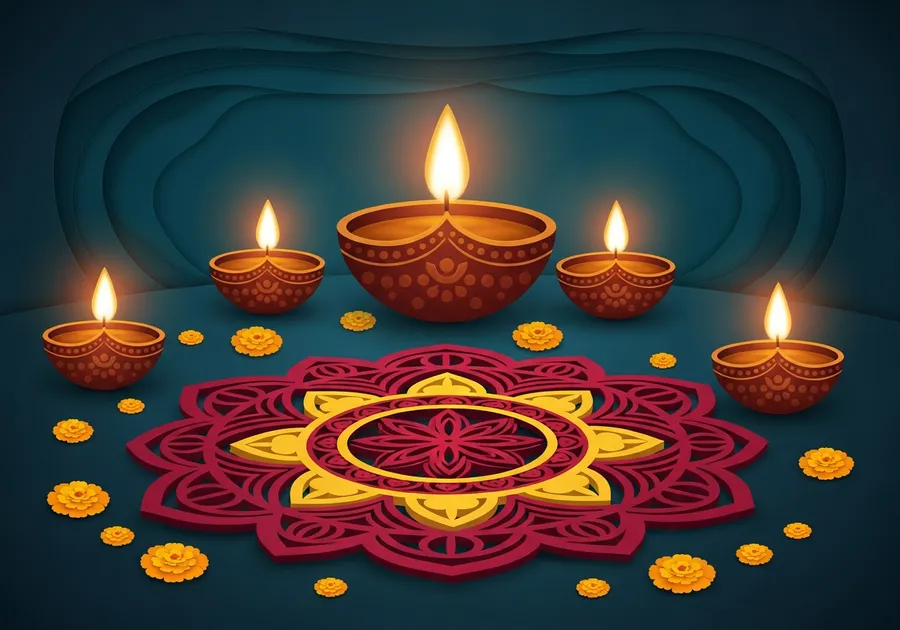
About Diwali
Diwali — formally Deepavali, meaning 'row of lamps' in Sanskrit — is a five-day festival rooted in the Puranic story of Lord Rama's return to Ayodhya after fourteen years of exile, when villagers lit clay diyas to guide him home. For Sikhs it commemorates the release of Guru Hargobind from imprisonment at Gwalior Fort in 1619, marked at the Golden Temple as Bandi Chhor Divas. For Jains it honours the spiritual liberation of Mahavira in 527 BCE.
For a deeper historical treatment, see Diwali — Wikipedia.
Each of the five days carries its own meaning: Dhanteras for prosperity, Naraka Chaturdashi for cleansing, Lakshmi Puja on the main night for wealth and well-being, Govardhan Puja for gratitude, and Bhai Dooj for the bond between siblings. Homes are scrubbed and decorated with rangoli, oil lamps line every threshold, and families exchange sweets — laddoo, barfi, kaju katli — alongside small gifts and handwritten cards.
Traditional greetings
The phrases below are the ones most often used to mark Diwali in person, by phone, and on cards. The native-script column shows the greeting as a recipient would read it; the transliteration is for those who would like to say it aloud; the English column is a literal rather than a poetic translation.
| Language | Greeting | Transliteration | English |
|---|---|---|---|
| Hindi | शुभ दीपावली | Shubh Deepawali | Auspicious Diwali |
| Hindi | दीपावली की हार्दिक शुभकामनाएँ | Deepawali ki hardik shubhkamnayein | Heartfelt Diwali wishes |
| Tamil | தீபாவளி நல்வாழ்த்துக்கள் | Deepavali nalvazhthukkal | Diwali good wishes |
| Bengali | শুভ দীপাবলি | Shubho Dipaboli | Auspicious Diwali |
| Gujarati | સાલ મુબારક | Saal Mubarak | Happy New Year (said the day after Diwali) |
| Punjabi | ਦੀਵਾਲੀ ਦੀਆਂ ਮੁਬਾਰਕਾਂ | Diwali diyan mubarakan | Diwali blessings |
Design tips for printable Diwali cards
Hand-printed cards for Diwali reward restraint and specific reference. The notes below distil what the most thoughtful cards in the tradition tend to do — and what the most commercial ones tend to get wrong.
- Anchor the card around a single hand-drawn diya rather than a row — one well-rendered lamp reads more clearly at greeting-card scale.
- Use a deep midnight or aubergine background and reserve gold for the flame, the rangoli linework, and the inside greeting only.
- Rangoli motifs scale beautifully in foil-effect gold or cut paper; keep symmetry but vary line weight to avoid a stencilled look.
- Pair Devanagari script for the headline greeting with a quiet serif (Cormorant, Cardo) for the English line beneath.
- For Lakshmi Puja cards, leave a small unfilled medallion at the centre as a place for a tilak or a printed gold seal.
A starting palette:
Five verses for Diwali cards
Each verse below is short enough to copy onto a folded card by hand. They progress from formal to intimate; pick the one that best fits the relationship and the year you are writing into.
- May every diya you light tonight stand in for a wish someone made for you — and may all of them come true.
- A row of small flames against a long night — that is family, that is friendship, that is what I wish you this Diwali.
- May Lakshmi find your door open, your rangoli fresh, and your heart turned toward gratitude. Shubh Deepawali.
- Light leaves the lamp, but never the giver. Sending you the warmth of one small flame across every mile between us.
- From our home to yours — sweets on the table, feet at the threshold, light in the windows. A blessed Deepavali to you and yours.
Related cultural holidays
Other holidays observed in the South Asia family of traditions: