About Kwanzaa
Kwanzaa was created in 1966 by Maulana Karenga, professor of Africana studies at California State University Long Beach, in the aftermath of the Watts uprising. He drew on the matunda ya kwanza ('first fruits') harvest festivals of Zulu, Ashanti and other African peoples, building from them a seven-night observance dedicated to seven principles (the Nguzo Saba): umoja (unity), kujichagulia (self-determination), ujima (collective work and responsibility), ujamaa (cooperative economics), nia (purpose), kuumba (creativity) and imani (faith).
For a deeper historical treatment, see Kwanzaa — Wikipedia.
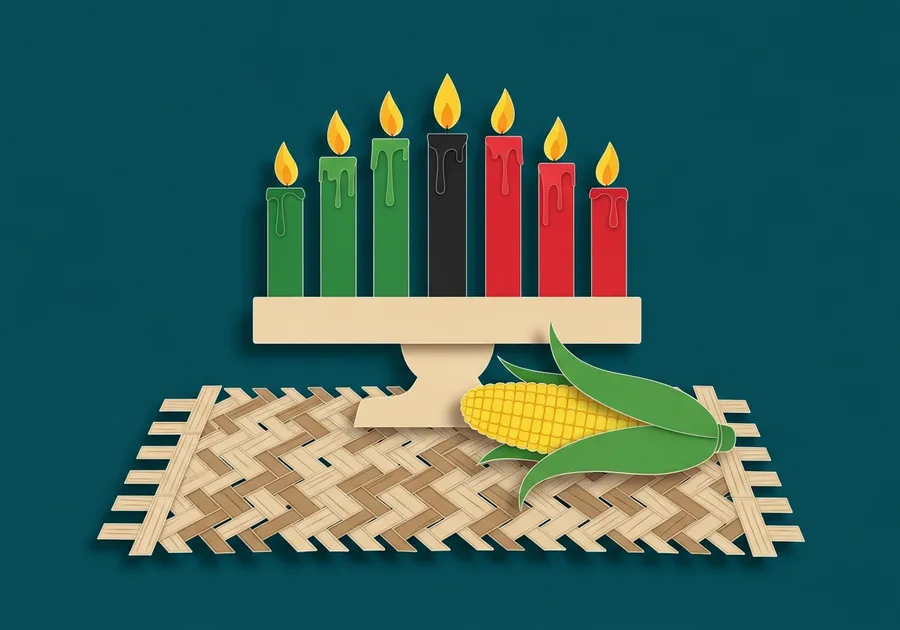
Each night a candle is lit in the kinara — three red candles for the struggle, three green for the future, and a single black candle in the centre for the people. Families gather around the mkeka mat, on which are placed the unity cup (kikombe cha umoja), an ear of corn for each child of the household, and the first-fruits offerings. The seventh night closes with the karamu feast. Kwanzaa is explicitly cultural rather than religious and is celebrated alongside, not instead of, Christmas, Hanukkah or no holiday at all.
Traditional greetings
The phrases below are the ones most often used to mark Kwanzaa in person, by phone, and on cards. The native-script column shows the greeting as a recipient would read it; the transliteration is for those who would like to say it aloud; the English column is a literal rather than a poetic translation.
| Language | Greeting | Transliteration | English |
|---|---|---|---|
| Swahili | Habari gani? | What's the news? (the daily Kwanzaa greeting) | |
| Swahili | Heri ya Kwanzaa | Happy Kwanzaa | |
| Swahili | Harambee | Let's pull together |
Design tips for printable Kwanzaa cards
Hand-printed cards for Kwanzaa reward restraint and specific reference. The notes below distil what the most thoughtful cards in the tradition tend to do — and what the most commercial ones tend to get wrong.
- The kinara — seven candles in red, green and black — is the most legible Kwanzaa image.
- Use the bendera ya taifa (red, black, green) as the only colour scheme; avoid Christmas-coloured crossover.
- Kente cloth pattern as an inner endpaper rather than the cover, which reads gentler.
- An ear of corn (muhindi) on the mkeka mat is a tender, specific reference for parents.
- Inside, leave room for the principle of the night the card will be opened on — the seven Nguzo Saba give the week its rhythm.
A starting palette:
Five verses for Kwanzaa cards
Each verse below is short enough to copy onto a folded card by hand. They progress from formal to intimate; pick the one that best fits the relationship and the year you are writing into.
- Habari gani? Today, the first principle — Umoja. Unity. May our family, our community, our race, our nation be lifted by it. Heri ya Kwanzaa.
- Seven nights, seven candles, seven small commitments to one another — blessings for your Kwanzaa.
- From the kinara to the kikombe to the karamu — the long, slow week of putting our principles on the table.
- May this Kwanzaa find your people gathered, your ancestors honoured, and your year ahead lit, one candle at a time.
- Harambee — let us pull together. Heri ya Kwanzaa from our family to yours.
Related cultural holidays
Other holidays observed in the Africa family of traditions: