
About Janmashtami
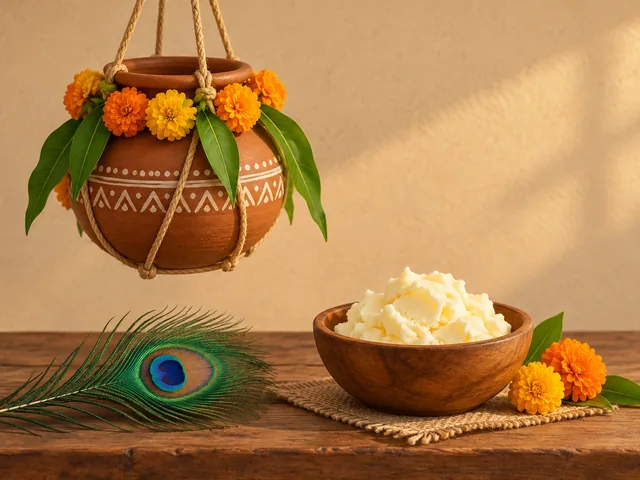
Janmashtami marks the birth of Krishna — the eighth avatar of Vishnu — at midnight in a Mathura prison cell, where his parents Devaki and Vasudeva had been imprisoned by the tyrant Kamsa. The story of Krishna's smuggling to safety in Gokul, his childhood mischief, his stealing of butter (makhan chori), and his teaching of the Bhagavad Gita underwrites the entire festival.
For a deeper historical treatment, see Krishna Janmashtami — Wikipedia.
Devotees fast through the day and break the fast at midnight after reading from the Bhagavata Purana. In Maharashtra and Gujarat the next day brings dahi handi — a clay pot of butter and curd is hung high above a street and human pyramids of young men and women, the Govindas, climb to break it, re-enacting Krishna's childhood pranks. Cards are usually sent to friends and elders the day before.
Traditional greetings
The phrases below are the ones most often used to mark Janmashtami in person, by phone, and on cards. The native-script column shows the greeting as a recipient would read it; the transliteration is for those who would like to say it aloud; the English column is a literal rather than a poetic translation.
| Language | Greeting | Transliteration | English |
|---|---|---|---|
| Hindi | जय श्री कृष्ण | Jai Shri Krishna | Glory to Lord Krishna |
| Hindi | कृष्ण जन्माष्टमी की शुभकामनाएँ | Krishna Janmashtami ki shubhkamnayein | Krishna Janmashtami wishes |
| Sanskrit | हरे कृष्ण | Hare Krishna | Praise Krishna |
Design tips for printable Janmashtami cards
Hand-printed cards for Janmashtami reward restraint and specific reference. The notes below distil what the most thoughtful cards in the tradition tend to do — and what the most commercial ones tend to get wrong.
- Peacock feather motifs reference Krishna's crown and scale beautifully in foil teal-and-gold.
- A single tilted clay pot with a thread of butter dripping is more affecting than a literal Krishna illustration.
- Use indigo blue — the colour Krishna is traditionally rendered in — as the dominant background, not the accent.
- For cards to children, lean into the dahi handi imagery: pyramids, breaking pots, scattering butter.
- Include a single line from the Bhagavad Gita inside — most families recognise the second-chapter verses immediately.
A starting palette:
Five verses for Janmashtami cards
Each verse below is short enough to copy onto a folded card by hand. They progress from formal to intimate; pick the one that best fits the relationship and the year you are writing into.
- Born at midnight in a prison cell, he became the friend of cowherds and the teacher of kings. Jai Shri Krishna.
- May the small mischievous god find your kitchen pot, your butter, your laughter — and take a little of each.
- Peacock feather in the hair, flute at the lip, and the world made a little gentler for it — happy Janmashtami.
- From the dahi handi smashing in the street to the small lamp at your home shrine — blessings for the night Krishna was born.
- The Gita's second chapter says: do your work, leave the fruit. A good wish for any year. Krishna Janmashtami ki shubhkamnayein.
Related cultural holidays
Other holidays observed in the South Asia family of traditions: