
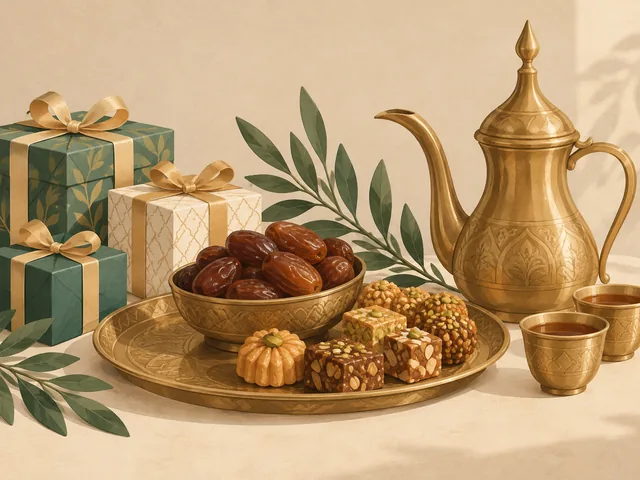
About Eid al-Adha
Eid al-Adha — 'the festival of sacrifice' — is the second of the two Eids and considered the holier of the pair. It commemorates the trial of the prophet Ibrahim (Abraham), who was commanded to sacrifice his son Isma'il (Ishmael) and, at the moment of submission, was provided with a ram in the boy's place. The story is shared by the Abrahamic faiths but, in Islam, the son is named as Isma'il and the location as the hill of Mina near Mecca.
For a deeper historical treatment, see Eid al-Adha — Wikipedia.
The festival falls on the tenth day of Dhu al-Hijjah, during the days of the Hajj pilgrimage. Families who can afford it perform the Qurbani, slaughtering a sheep, goat, cow or camel and dividing the meat into thirds — for the household, for relatives and friends, for the poor. The day begins with the Eid prayer, includes new clothes and home visits, and is generally more reflective and less giddy than Eid al-Fitr.
Traditional greetings
The phrases below are the ones most often used to mark Eid al-Adha in person, by phone, and on cards. The native-script column shows the greeting as a recipient would read it; the transliteration is for those who would like to say it aloud; the English column is a literal rather than a poetic translation.
| Language | Greeting | Transliteration | English |
|---|---|---|---|
| Arabic | عيد أضحى مبارك | Eid Adha Mubarak | Blessed Eid of Sacrifice |
| Arabic | تقبل الله منا ومنكم | Taqabbal Allahu minna wa minkum | May Allah accept it from us and from you |
| Turkish | Kurban Bayramınız mübarek olsun | May your Eid of Sacrifice be blessed | |
| Indonesian | Selamat Idul Adha | Happy Eid al-Adha | |
| Urdu | عید الاضحیٰ مبارک | Eid al-Adha Mubarak | Blessed Eid al-Adha |
Design tips for printable Eid al-Adha cards
Hand-printed cards for Eid al-Adha reward restraint and specific reference. The notes below distil what the most thoughtful cards in the tradition tend to do — and what the most commercial ones tend to get wrong.
- Eid al-Adha cards traditionally lean more toward Hajj imagery than feast imagery — the Kaaba in silhouette, the crescent over Mecca.
- Sheep and ram silhouettes are appropriate but easily clichéd; abstracted, almost calligraphic line drawings work better than literal renderings.
- Deep maroon and brass instead of green and gold sets these cards apart from Eid al-Fitr ones.
- For recipients on Hajj, a card sent ahead with a note saying "may yours be accepted" is the customary form.
- Inside, the line "Taqabbal Allahu minna wa minkum" is the standard greeting, written in Arabic with English beneath.
A starting palette:
Five verses for Eid al-Adha cards
Each verse below is short enough to copy onto a folded card by hand. They progress from formal to intimate; pick the one that best fits the relationship and the year you are writing into.
- Eid Adha Mubarak. May your sacrifices, large and small, be accepted in full.
- From the slope of Mina to the door of your home, the same blessing travels. Taqabbal Allahu minna wa minkum.
- May the example of Ibrahim — willing, then spared — teach us both how to hold and how to release.
- A third for the family, a third for the friends, a third for the neighbour you have never met — that is the table of Eid al-Adha.
- Whether on the hill in Mecca or at home with the family, may this Eid find you accepted, fed, and at peace.
In the Greet Grove directory
The full directory entry for Eid al-Adha — including its calendar dates, source attribution, and any additional verses — is on the occasion page.
Related cultural holidays
Other holidays observed in the Middle East & North Africa family of traditions: