
About Chuseok
Chuseok — also called Hangawi, 'the great middle' — falls on the harvest full moon and is, with Seollal, the most important holiday in Korea. Its origins are traced to a weaving contest between two teams of women in the Silla kingdom over a thousand years ago; the losing team had to prepare the feast that closed the moon-festival, and the rite of communal harvest-eating became a national tradition.
For a deeper historical treatment, see Chuseok — Wikipedia.
Modern Chuseok is a three-day public holiday during which most Koreans travel to their family hometowns — the highways and KTX trains are famously full. Families perform charye, a memorial rite for the previous four generations of ancestors, and visit graves to clear weeds (seongmyo). Songpyeon, half-moon-shaped rice cakes filled with sesame, beans or chestnut, are made together by hand the night before. Cards are exchanged between colleagues and friends, often arriving with seasonal gifts of fruit or beef.
Traditional greetings
The phrases below are the ones most often used to mark Chuseok in person, by phone, and on cards. The native-script column shows the greeting as a recipient would read it; the transliteration is for those who would like to say it aloud; the English column is a literal rather than a poetic translation.
| Language | Greeting | Transliteration | English |
|---|---|---|---|
| Korean | 추석 잘 보내세요 | Chuseok jal bonaeseyo | Have a good Chuseok |
| Korean | 한가위 보름달처럼 풍성하세요 | Hangawi boreumdal-cheoreom pungseonghaseyo | May you be as full as the Hangawi full moon |
| Korean | 즐거운 한가위 되세요 | Jeulgeoun Hangawi doeseyo | Have a joyful Hangawi |
Design tips for printable Chuseok cards
Hand-printed cards for Chuseok reward restraint and specific reference. The notes below distil what the most thoughtful cards in the tradition tend to do — and what the most commercial ones tend to get wrong.
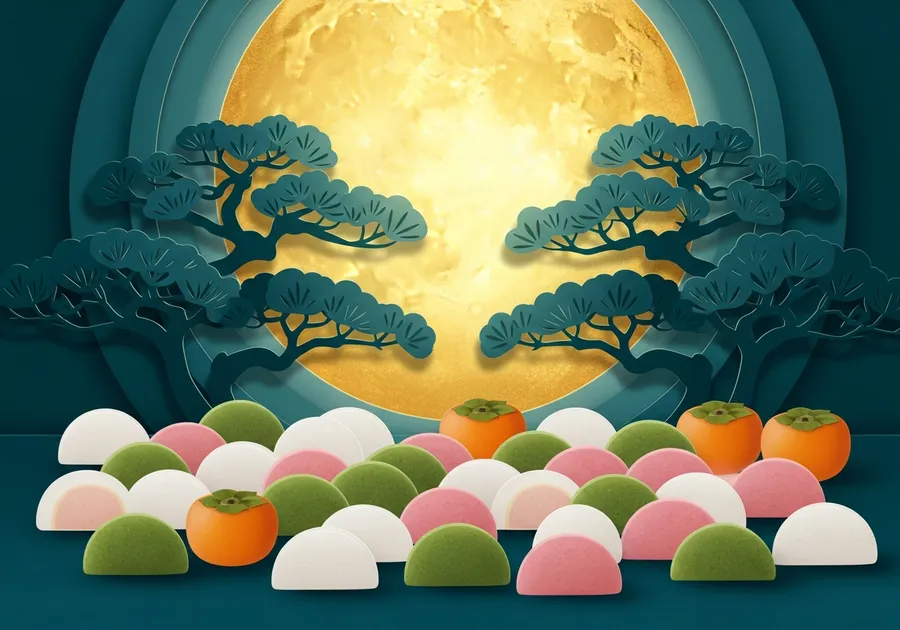
- A full harvest moon over a low pine silhouette is the most recognisable Chuseok image.
- Songpyeon — small half-moon rice cakes — make a beautiful repeating pattern.
- Persimmons (gam) at peak orange are the season's signature fruit and warm any palette.
- Use hanji (Korean mulberry paper) textures as the background.
- For diaspora cards, include the date in both the Gregorian and lunar calendar.
A starting palette:
Five verses for Chuseok cards
Each verse below is short enough to copy onto a folded card by hand. They progress from formal to intimate; pick the one that best fits the relationship and the year you are writing into.
- May this Hangawi find you full — as full as the harvest moon it sits beneath. Chuseok jal bonaeseyo.
- From our songpyeon to yours, from our family table to yours, a great middle of a year to you.
- Persimmons at peak, the moon at its roundest, and the long highways home full of people who love each other. Happy Chuseok.
- May the ancestors' rite be done well, the charye table set with care, and the rest of the day be soft.
- Hangawi boreumdal-cheoreom pungseonghaseyo — may your year be as round, as bright, and as quietly generous as tonight's moon.
Related cultural holidays
Other holidays observed in the East Asia & Pacific family of traditions: